






By the JBR Battery team · Updated · 6 min read
The short answer
Car batteries in Dubai typically last two to three years, compared with four to five years or more in cooler countries. Heat is the cause: it speeds up corrosion inside the battery and dries out the electrolyte. Short trips, long idling with the AC on and weeks parked unused can cut that to under two years.
How long does a car battery last in Dubai?
A car battery in Dubai typically lasts two to three years. The same battery in a temperate country such as the UK or Germany typically lasts four to five years, and sometimes longer. The difference is not the brand or the car. It is the temperature the battery lives in for most of the year.
Those figures are ranges, not promises. A car that is driven daily on Sheikh Zayed Road and parked in a cool basement can pass three years without trouble. A car that makes five-minute trips between JBR and Dubai Marina, or sits under the sun for weeks, can need a new battery in under two years.
Why does heat kill car batteries?
Heat kills car batteries because it speeds up every chemical reaction inside them, including the ones that wear the battery out. In cold countries a battery fails on a winter morning. In the Gulf it is damaged during summer, and it is heat, not cold, that does the damage. A widely used rule of thumb in the battery industry is that life roughly halves for every 8 to 10°C rise in average battery temperature above about 25°C.
Summer air temperatures in Dubai regularly pass 40°C, and the air under a bonnet after a drive is much hotter than that. Three things happen inside the battery:
- Grid corrosion. The lead grids that hold the active material and carry current corrode faster when hot. They become thin and brittle, and the battery loses its ability to deliver a strong starting current.
- Water loss. Heat and charging drive water out of the electrolyte. In a sealed battery that water cannot be replaced, so the acid becomes more concentrated and the tops of the plates can dry out.
- Self-discharge. A parked battery loses charge on its own, and the rate roughly doubles with each 10°C rise. A battery that sits partly discharged forms hard sulphate crystals on its plates, known as sulphation, which permanently reduces capacity.
What shortens battery life further in JBR and Dubai Marina?
Short trips, long idling, long periods parked and constant small electrical loads shorten battery life further, because each one leaves the battery partly discharged in the heat. Starting the engine takes a large burst of energy, and the alternator needs a proper drive to put it back.
| Usage pattern | What it does to the battery | What to do |
|---|---|---|
| Short trips around JBR and the Marina | The alternator never fully replaces the energy used to start the engine, so the charge level drops a little each day. | Take a drive of 30 minutes or more once a week, and test the battery every few months. |
| Long idling with the AC on | At idle the alternator produces less, while the blower, cooling fans and lights draw a lot. The battery can end up covering the gap. | Avoid long waits with the engine idling. If it is part of your daily routine, test the battery more often. |
| Car left parked while you travel | Self-discharge and the car's own standby loads drain the battery. After three to four weeks in summer it can be too low to start. | Ask someone to drive it for 30 minutes every week or two, or connect a smart maintenance charger if your parking bay has a socket. |
| Open-air parking in the sun | The battery soaks up heat all day, which speeds up corrosion and water loss. | Use shaded or basement parking where you can. A tower basement is kinder to a battery than an open beach car park. |
| Dashcams and trackers | Parking-mode dashcams and GPS trackers draw power around the clock. The drain is small, but it adds up on a car that is not driven daily. | Set the dashcam's low-voltage cut-off, or switch off parking mode when the car will sit for days. |
How do you tell how old your battery is?
You tell a battery's age from the date code on its case or label, or from the fitting invoice. Most batteries carry a sticker or a code stamped into the plastic that shows the month and year of manufacture or dispatch.
The format varies by manufacturer. Some labels show it plainly, such as 04/25 for April 2025. Others use a letter for the month, with A for January and B for February, followed by a digit for the year. If the code makes no sense, check the service invoice or warranty card, or ask a technician to read it. A battery fitted at the factory is the same age as the car, so a three-year-old car on its original battery is already at the end of the usual Dubai range.
How do you check battery charge with a voltmeter?
You check the state of charge by measuring the resting voltage across the terminals with the engine off. Let the car sit for a few hours first, because a battery that has just been driven or charged reads falsely high. A basic multimeter is enough.
| Resting voltage | Approximate state of charge | What it means |
|---|---|---|
| 12.6 V or higher | Full, about 100% | Healthy charge level. AGM batteries often rest slightly higher. |
| About 12.4 V | About 75% | Acceptable, but the battery would benefit from a longer drive. |
| About 12.2 V | About 50% | Low. Recharge soon and find out why it is dropping. |
| 12.0 V or less | About 25% or less, discharged | May not start the car. Recharge and test before relying on it. |
Voltage shows charge, not condition. A battery near the end of its life can show 12.6 V and still fail under the load of the starter. Only a proper test with a conductance or load tester, which measures how much starting current the battery can still deliver, tells you its real health.
When should you test and when should you replace?
Test the battery once a year for its first two years, then before every summer, and replace it proactively once it is past about two and a half to three years and a test shows it weakening. The sensible time is April or May, before the hottest weeks, when failures are most common and a breakdown means waiting in the heat.
- Replace it if the battery is over three years old and the car is slower to start than it used to be.
- Replace it if a test shows the measured starting current well below the rating printed on the label.
- Replace it if it has gone flat and needed a jump start more than once.
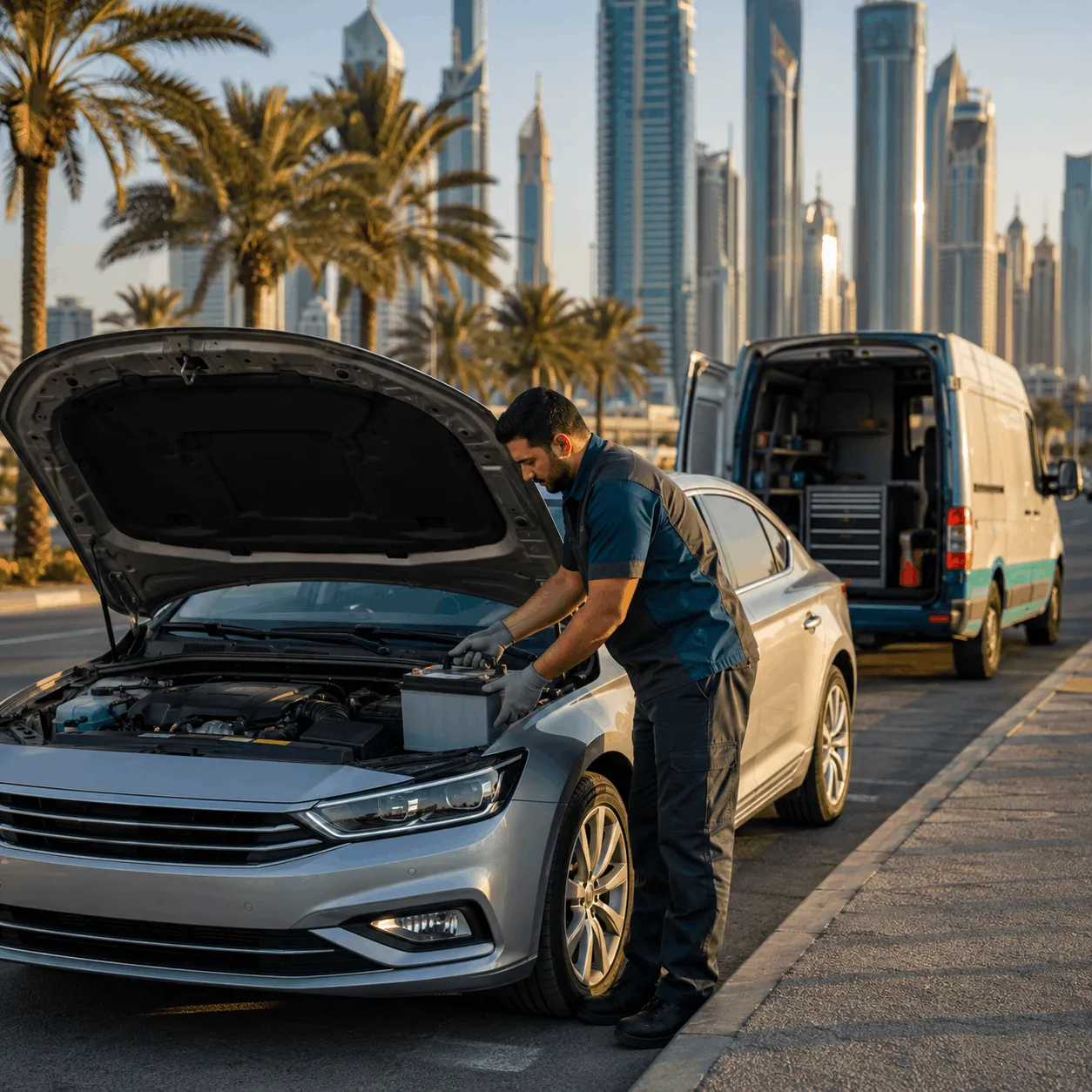
A test takes a few minutes and can be done where the car is parked. JBR Battery technicians test batteries in tower basements, podium car parks and on the street, 24/7, and fit a replacement on the spot only if the test shows one is needed. New batteries carry a warranty of up to 24 months.